

It is 11:30 PM, your body is exhausted, and your mind is still running through a spreadsheet of possibilities. You are replaying a three-minute conversation from earlier in the afternoon, checking whether your tone sounded dismissive, rehearsing what you should say in tomorrow's meeting, and trying to anticipate every possible outcome of a decision that is still weeks away.
From the outside, you likely look capable, prepared, and dependable. People may even rely on you because you think ahead and rarely drop the ball. Yet inside, overthinking and anxiety can feel like a browser with forty tabs open that never closes. You tell yourself to just let it go, take a deep breath, or get some sleep - and five minutes later, your mind is right back on the problem, turning it over from another angle.
If you have ever wondered why you cannot simply turn off the mental noise, it can be deeply relieving to look at what is happening beneath the surface. Rather than a flaw in your wiring or a sign that you are broken, chronic overthinking is often the work of a deeply dedicated protective part of you that believes figuring everything out is the only way to stay safe.
When Thinking Becomes a Way to Stay Safe
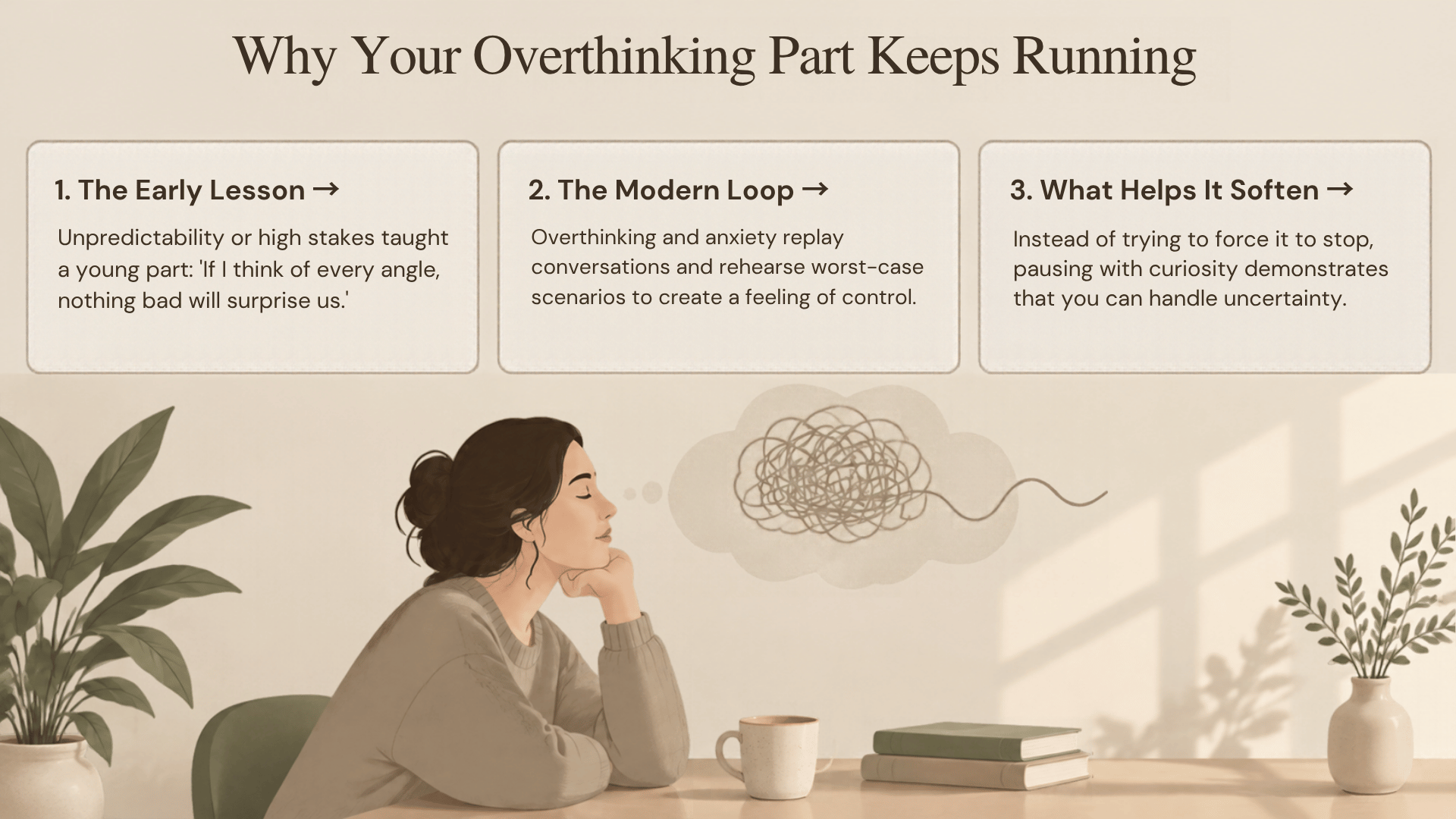
For many thoughtful, high-functioning adults, overthinking did not start as a bad habit. It started as a smart strategy in an environment where being caught off guard felt costly.
Maybe you grew up in a household where moods shifted without warning, and staying two steps ahead helped you read the room and keep the peace. Maybe love, praise, or stability felt closely tied to performing well, making the right choice, or not causing trouble for the adults around you. Or perhaps nobody had the bandwidth to help you sort through big feelings when you were young, so you learned early on to retreat into your head and solve problems on your own.
When your nervous system learns that uncertainty leads to disappointment, conflict, or rejection, your mind becomes your primary shield. If you can analyze every variable, predict every objection, and mentally rehearse every possible disaster before it happens, you might be able to prevent the pain altogether.
If this is you, it makes complete sense - this is how human survival works. Your mind learned to work overtime because, at one point in your life, vigilance was the most reliable tool you had.
How Internal Family Systems Understands Overthinking
When people explore what Internal Family Systems therapy is, one of the most helpful shifts is realizing that the mind is not a single, unified narrator. Instead, each of us carries an internal ecosystem of "parts", distinct sub-personalities with their own memories, fears, and protective jobs.
Within Internal Family Systems (IFS), an overthinking part is typically what we call a manager part.
Managers are proactive protectors. While younger, more vulnerable parts of you hold past wounds like shame, helplessness, or fear of abandonment, manager parts stay on duty around the clock to make sure those tender feelings never get triggered again. They organize your life, plan ahead, and try to keep everything under control.
An overthinking manager part often works closely alongside a harsh inner critic, using constant mental analysis to protect you in a few specific ways:
Preventing mistakes before they happen: If it can spot every flaw in your plan ahead of time, you will not have to feel the sting of failing or letting someone down.
Protecting against rejection in relationships: By analyzing texts, facial expressions, and past conversations, it tries to detect any sign of disconnection early so you can adjust before someone pulls away.
Creating an illusion of control: Uncertainty can feel terrifying to younger parts of your system. Staying busy in your head gives the reassuring sensation that you are actively doing something to keep yourself safe.
Keeping vulnerable emotions at a distance: As long as your attention stays locked on solving a logistical puzzle in your head, you do not have to drop down into your body and feel grief, sadness, or fear.
Think of this part like background software that was written years ago for much harsher conditions. Even though you are now an adult with real choices, resources, and resilience, that old program keeps running silently in the background. It has not yet been updated to trust who you are today or the actual safety of your present life.
From the vantage of this overthinking part, stopping the analysis feels like stepping onto a tightrope without a net.
Why Overthinking Is Anchored in the Nervous System
Many people who reach out to an Internal Family Systems therapist already know, on a logical level, that they are overthinking. You can see that rehearsing a conversation ten times will not change the outcome, and you know that no amount of midnight worrying can guarantee a smooth week.
Yet knowing that intellectually rarely stops the loop.
That is because overthinking and anxiety are not purely cognitive problems - they are rooted in survival physiology. When an uncertain situation like an unanswered message, or an upcoming decision registers as a potential threat, your nervous system shifts into a subtle fight-or-flight state. In the blink of an eye, your nervous shifts into the tried-and-true strategy it developed decades ago.
When your body is braced for impact, telling yourself to "just stop worrying" feels threatening to your protective system. To your overthinking part, letting down its guard sounds reckless. Before that part can loosen its grip, your nervous system needs enough grounded, present-day steadiness to register that uncertainty is not an emergency.
Shifting From Mental Spin to Gentle Curiosity
When we get tired of our own overthinking, our first instinct is usually to fight it. We get frustrated with ourselves for spiraling, try to force our minds to go blank, or judge ourselves for not being more relaxed.
In IFS, we approach this differently: healing doesn't require declaring war on the parts of yourself you don't like.
When you argue with an overthinking part or try to shove it away, it usually concludes that you do not appreciate the danger it is trying to prevent - so it turns up the volume. Curiosity interrupts that tug-of-war.
The next time you notice your mind spinning on a loop, try pausing for just ten seconds. Instead of diving into the content of the thoughts to prove them right or wrong, see if you can notice the thinking itself as a part of you that is working very hard right now. You might gently ask:
What is that part protecting right now?
What is this part afraid would happen if it stopped trying to figure this out for the next hour?
How old does this part think I am?
Even a tiny pause creates space between you and the spiral. In IFS, we call that calm, curious, grounded presence Self-energy. You do not have to have all the answers to access it; simply noticing that a part of you is worried - rather than being completely taken over by the worry - begins to shift the internal atmosphere.
Why Lasting Relief Takes Time and Internal Safety
Recognizing that your overthinking part is trying to protect you often brings a wave of compassion, though genuine change happens gradually. A part that has spent decades standing watch at the door will not clock out after one insight.
In unhurried, depth-oriented therapy, we do not try to strip away your coping strategies before your system is ready. First, we focus on reminding your nervous system that you are safe and building a steady, respectful relationship with your protective parts. As you grow mastery and confidence to recover from big and small triggered states, your system begins to experience what it feels like to stay anchored even when life is uncertain.
Over time, when your overthinking part sees your grounded adult Self consistently showing up, navigating hard conversations, and handling imperfection without falling apart, it no longer has to run the whole show. Its sharp, anxious vigilance can gradually soften into thoughtful discernment - a resource you can call on when you actually need it, rather than a siren that never turns off.
Exploring Internal Family Systems Therapy in California
If you are exhausted by the constant mental noise of overthinking and anxiety, and you are ready to understand what those protective parts are carrying beneath the surface, you do not have to untangle it alone.
In my practice, I work as an Internal Family Systems therapist offering virtual therapy for adults across California. Integrating IFS with neurobiologically informed approaches, I provide a calm, unhurried space where thoughtful, self-reflective adults can slow down, get to know their protective parts with curiosity, and build lasting internal safety.
Based in the San Francisco Bay Area, I offer secure online sessions statewide throughout California. If you are curious about working together, I invite you to learn more on my individual therapy page or reach out through my contact page to schedule a complimentary 20-minute initial consultation.
Come as you are. You do not need to navigate this alone.
Educational Disclaimer: Educational & reflective content only. Not medical or psychological treatment. Does not establish a therapist-client relationship.
Crisis Resource: If you are experiencing an acute mental health crisis, please reach out to the Suicide & Crisis Lifeline by calling or texting 988 (US), or contact your local emergency services.